Version 234 of Your Deck? Still ZERO VC Interest? Fix This
Are you getting ghosted by VCs even if you spend hours and hours and hours reviewing your decks and you have great traction, great team, but still you're not getting any answers? Well, I've helped raise over $130 million with many different founders in very different industries like Veevin, Veevinci.
They raised $ 32 million like mindset mindset here go to them they raised 13 million and who else can I show you as pirate here go spy cut 2 million for the stairs a bottom line it only happened because I focus on three very specific things and those things are not traction team ask like whatever right there are things that are outside of that realms so in this video i'm going to show you what those three obsession are and how you can apply them to your fundraising to dramatically increase the number of vesicle you're getting and therefore how much money you're raising so let's start with obsession number one. This mistake alone is what make most pitch deck fail
in the first couple of minutes. And to be honest, I spoke with a lot of different advisor, this is never something that I hear other advisor saying. It's all about how VC process your deck. And the thing is, if you don't get that, VC will just ignore you. Ignore you. So here's how it works. Think about the last time you picked up a newspaper. get that, a VC will just ignore you.
So here's how it works. Think about the last time you picked up a newspaper. The mindset that you have when you do that is not to study it deeply, right? You just look at the newspaper to get a sense of what's happening in the world. You flip the page quickly, you look at this section, and you try to find something that grabs your interest.
Politics, economics, you know, whatever you like. And if nothing pulls you in immediately, you just keep flipping until you find something that grabs your interest politics economics you know whatever whatever you like and if nothing pulls you in immediately you just keep flipping until you find something that grabs your attention now imagine that same newspaper with sometimes a lot of text sometimes very small title big title changing of colors sometime page with just images with no text nothing nothing to
indicate you nothing to guide you nothing for you to understand what could be in that specific part of the newspaper. It would be much harder to get those information, right? And probably you would put it, you would put the newspaper down much faster, right? Because you're like, ah, it's annoying. You cannot, I cannot get what's, what this is about.
Boom. You just throw it, right? This is exactly the same thing that happened with VCs, the same thing. And this is where your chance to get a meeting just failed after the VC just opened your deck. This is because science shows us that we have something called the working memory. And the way it works is that your brain can only have two or three information at the same time.
Like if you're trying to understand something, if there's more than those two, three it kind of fell apart right and so when you have a VCS that obviously that spend hours reviewing that in a row right I spoke with VC I have some of my podcast and and it's crazy like sometimes they reviews literally a hundred of paycheck and so once the VC open your deck he's trying to make a decision here.
He's trying to know like, hey, should I move forward with that person or not? But then imagine you give them that newspaper with random organization of information. How could they grasp what you're trying to do, right? Because they're trying to read out your headline and then they grab something else on the slide, something else, then they go to the next slide and it's something new again and they're like oh what the fuck am I getting here? They struggle to get the information, they just get overloaded. And so when they get overloaded they're like, you know, I
don't care about that, it's probably bad. Because they'll jump to the wrong conclusion, right? They'll be like Formatting I cannot understand from the formatting at heart for me to get information So other VCs will also struggle to get information. So here and that's the worst part I'm not missing out because nobody will pay attention to that startup.
So why should I I'm not missing out ciao I'm leaving and that's why up get dismissed not because what you're doing intrinsically is bad but how you're trying to communicate to to share information about what you do that is bad so the question is how do you stop that from happening how do you actually get vcs to start caring about what you do so back in, when I started to make pitch deck professionally, I wanted to understand what makes a startup fundraise or not, right? So I went back and I studied hundreds of companies to better understand what make a startup raise or not.
And I looked at everything. So I got my hands on a lot of white C-decks and startup that raised here 3.3 million, here 3 million, 22 million, you get it, a lot of millions right? And what I did is that I tried to understand what works, what doesn't work.
Different industry, different stage, but the reality is that they all use the same trick all of them that's one simple thing that makes your deck just much more understandable and that gets VC to pay attention and to have the first step of like yeah I'm gonna look at that deck and the key here is their structure the slide structure that's it and I believe that this is the one piece that really helped me early on to build my portfolio and to help founder the slide structure, that's it.
And I believe that this is the one piece that really helped me early on to build my portfolio and to help founder fundraise is by respecting that specific structure. So let me show you what is that structure and how does it work? So let's take the example of Rippling. It's a YC company that raised millions and millions of dollars and you probably know them.
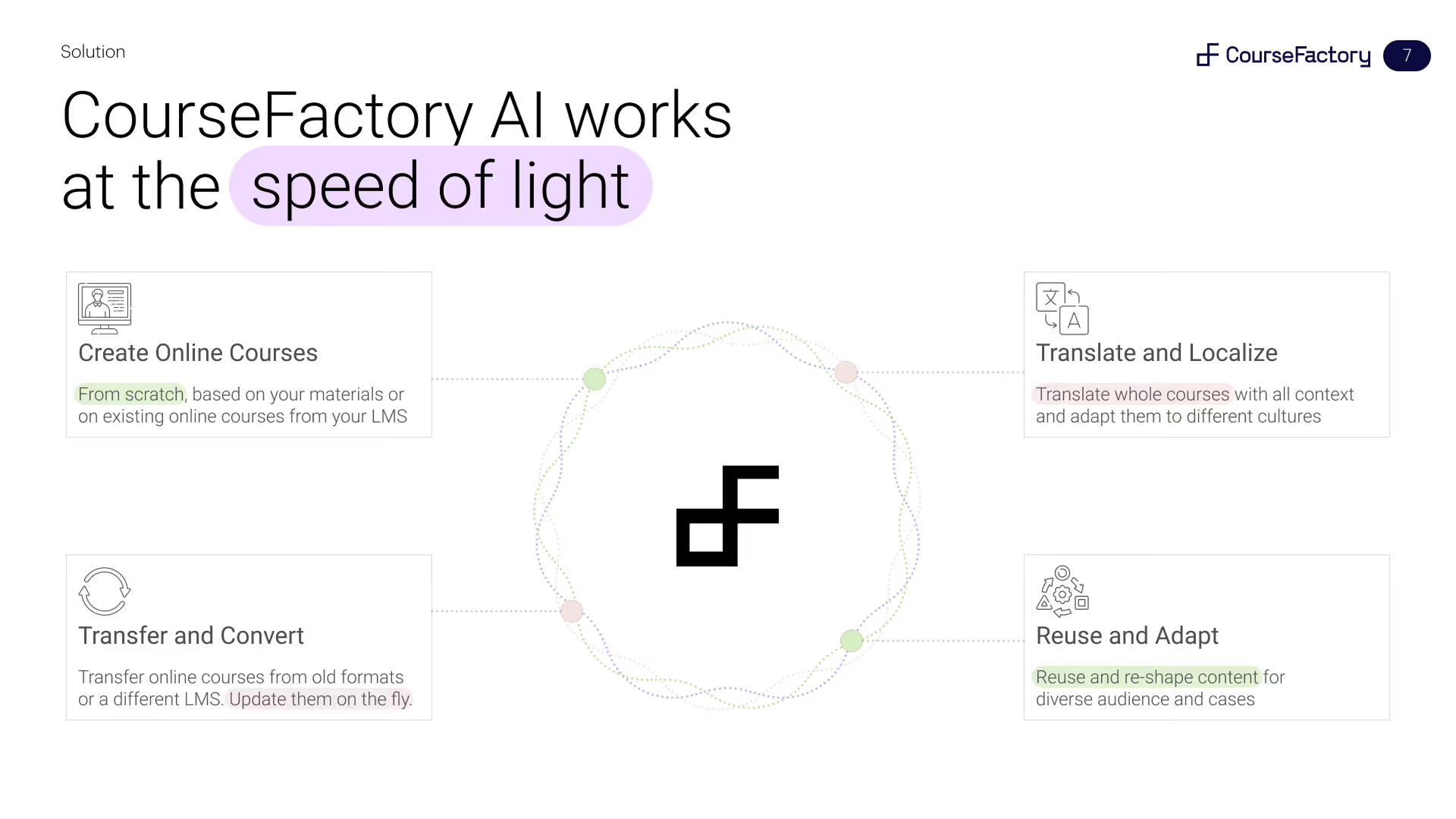
And they use the same formula for every single one of their slide and i think it's a good representation of what is a good slide right so let's break it down first and most importantly a headline here boom so you start you read it and then what they do and i think that's really the magic of it it's like if you look at the headline rippling centralized employee data across all system and so here what you do is that you take the headline rippling centralized employee data across all systems. And so here, what you do is that you take the headline,
rippling centralized employee data, boom, you caught it. So here, boom, it's one part of the sentence. And then the first part of the sentence here relates to this part here. So if you look, this is the idea that is centralized, the information, right? And then you have across all systems which is this part right so you have two part headline that summarize the content of the whole slide right so the key here is that there's no new information in this part here it's just expended on expended on what's in the headline.
And the magic here is that this slide leave you with two clear takeaway, right? It doesn't try to push too many things like centralize the data across all system. That's it. One headline, two ideas, nothing more. And so yeah, like if a company like Rippling can do that, you can probably too. And I'm sure that now you see that you're like yeah like someone looking at that slide kind of hard not to understand what's happening here like it's it's so simple right but why does that structure work so well and this is the magic part well not
really magic just science and it go back to what i said before with your working memory, right? It's like your brain can only capture two or three information at the same time. So when you have this, it just connects, right? And the other thing is that it follows something called the F-patterns. And what's the F-pattern? It's like, if you're a human, when you look at a document, it's proven that people start to read the headline, right? And that's a mistake I see so many, so many, so many times.
It's like people will put, you know, very important information in another part of the headline. I'm like, hey, nobody will read that, right? And so if it's an important information, you'll just get obliterated because nobody will read that information. And if you put something that you expected someone to read well that thing won't be read whereas when someone look here to look at the headline like oh okay I got it then you look at this line is like hey I confirm that and this is where the working memory come back it's like when
you understand something it goes in another place in your brain it doesn't doesn't it's not in your brain anymore right it's just it goes in your deep memory right and so you're you're part of the brain that's trying to figure shit out don't if the shit is explained clearly it's get freed up like hey I have new space in my brain to try to understand things because I already understood the previous one right and this is why you need that format so now do me a favor apply this to your deck and VC will actually read your deck right they will actually read it now and
this is where my second obsession come in like it's one thing to have VC look at your deck but now like what should you tell them so they feel like damn this this this is this is interesting i i want to to learn more about it how do you make them curious how do you make them want to learn more about you and investigate if that's really an opportunity and that's the key word that's my second obsession you'll often hear hey you know pitch me your startup but you should not actually pitch your startup last week i was doing a fundraising workshop
with one of the Accelerator I work with. And at the beginning of the workshop, I was like, hey guys, can you quickly introduce me to what you're doing? I'd just like to get a brief idea so I can use your startup as an example in the workshop. And every single founder did the exact same thing. And to be honest, it's not just limited to early stage startup and then Accelerator.
I see that with series A and series B founder. It's a mistake that is done at every level. And so in the workshop, they all answer the same thing. Hey, so this is my product. Here's how it works. Here's why it's better than the alternatives, blah, blah, blah, blah, blah. And their assumption was simple.
Simple, if you understand what I do, you'll be excited about what I do. That feels logical, right? Maybe, but it's really not how it works. It's not how you get someone curious and excited about your startup. You should not speak about your startup, or not at least in that way. Because understanding what you do is not what triggers the VC decision.
Your product is not why a VC invests. Instead, and that's the key sentence, I'm so proud I wrote that, it's like, you should present your startup as a vehicle to present an opportunity. Your startup is not the opportunity. Your startup is the vehicle to access an opportunity. Let's unpack that.
There's a simple example to explain you that think about the gold rush and the shovels in the gold rush we can be pretty sure that in that time shovel companies shovel startups did pretty well right and that it could have seen as a great investment but let's unpack why nobody showed up in cal because someone had invented a wonderful new shovel right no they showed up in California because there was a gigantic opportunity massive deposit of gold huge upside asymmetric outcomes so our startup here let's call it shovel II I'm sure that no I was gonna start a bad
joke let's just keep it let's just call it chav if that startup succeeded, it didn't succeed because shovels were interesting. The shovel startup only succeeded because it attached itself to the opportunity, to the gold rush, to everything that gravitated around the gold rush. Their business only made sense in that context, in the context of thousands of miners, need for equipment, and people dying, literally dying for gold. The opportunity was the gold rush and the shovel company was only valuable because it
attached itself to it. And so if we bring it back to the VCs, they'd probably be only interested about the shovel companies because they were gravitating around that big opportunity because that startup was in the game of enabling others to access that big opportunity. And this is why, if you think about it, at the same time, a shovel startup in farming would have probably done far less well same product different market different opportunity but why is it so important to have a big market right you
could argue that that you know shovel company for farming would have done pretty well this matters because this is how venture capital works venture capital don't care they really don't care about good businesses like as a matter of fact i have a client that have 500K in ARR in less than one year struggling to get investment. I've actually invested in that company, but I'm not a VC.
VC care about investing in a startup. And there's a big difference between being a good business and a startup. It follows a very simple economical logic. VCs are trying to find companies that can scale very fast so they can return the whole fund. And because most startup fails, average or good startup of good company, they don't care.
They need a small number of extreme winners. So when a VC open your deck, they're not evaluating your product in isolation, like, oh, is this a good product or not? They're asking a very different question. Is this company positioned in a market that have a huge scaling potential? If the answer is not clear, nothing else really matters.
Only once the upside is understood, then you get a chance for more information and for curiosity. And that is what makes a pitch deck work. Once the VC understands that you have a vehicle that can leverage this large opportunity, only then they start to care and be like, yeah, let's have a conversation.
I think you're looking at something big. You need to show that this is big. And once that's understood, life becomes much, much much much easier in your fundraising so now that you know how to structure your pitch deck that you know that you need to present the opportunity how do you present your opportunity and if you don't know how to present the opportunity it could still mean that nobody will understand like nobody will actually care so now you're at that critical moment you know how to present your startup you know that you need to present yourself as a vehicle to leverage an opportunity but how do you show that
how do you show that you are the vehicle to present that opportunity how do you build the momentum so that someone look at this like wow this is strong This is the art of presenting an opportunity. And this is the exact art that I mastered in the last four years now. And I came up with an incredible sequence.
And to be honest, it delivers incredible results. And once you implement it, you will stop doubting about your pitch deck and you'll be much more comfortable when you pitch to VCs. And trust me, that makes the whole difference. So let's dive in my obsession number three. Even when the slides are clear, even when the opportunity is real and you understand you need to present an opportunity, the key here is how to reveal it.
After reviewing hundreds of hundreds of decks, I see founders making the same mistake all the time. All the time. They open with the market side. Imagine you're Airbnb. The hospitality industry is an X billion dollar market. You look at this and you're like, yeah, great, but how does that relate to you? How does that, you know? You don't know.
They start with the destination instead of starting with the journey to the destination. The number is technically impressive, right? 100 billion. But billion means nothing without a great story to support it. There's no tension. There's no logic. Nobody cares about this number at the very beginning of your day. Nobody cares. But hopefully, there's a logic, nobody cares about this number at the very beginning of your day.
Nobody cares. But hopefully, there's a very easy fix for that. And I'm sure you've actually seen it, just not in a pitch deck creation context. Just again, I'm telling you, you probably know the rule. Let's take an example. Imagine you're in 2001. You just heard about a new movie coming out, The Lords of the Ring.
Ta-da. Weird name, but you know, you decide to give it a chance and have a look. But you're super disorganized and you arrive late to the cinema. You run to the door, you're really late, you open the door and boom. And you see, and the scene you just captured is the rain the rain falling into that little lava pit right and you look at this and you're like yeah sure laughing you know looks good good you know for that time it was pretty good you know movie you know 3d design you're like yeah that's pretty
cool but then you look around you and you see everybody else being much more agitated about this than you. You're like, hey, it's not such a big deal, right? It's just a ring. What's the matter here? Why do you react like that? You react like that because you just arrived at the biggest point of the story, right? And you have zero context the other in the room they've been here for three fucking hours so when they see the rain they're like wow well you're right and you're like well I don't care so much
right that's the same thing with your pitch deck. We get it? The opportunity is your climax. And the climax only work after you build tension. Front raising work the same way. Let me show you how. If you want to raise your next round, you need to start implementing, I know it's a buzzword, but it works.
You need to start implementing storytelling in your deck and tactically reveal your opportunity. And here's how. And since I'm sure you love my shovel example, let's use it one more time in here. Just like the Lord of the Rings, like you don't start with the ring falling in the lava pit, right? The movie starts by giving you some context.
You see the Shire, you see the happy people, and you get an idea of the world before anything goes wrong. And when you pitch your startup, you see the happy people, and you get an idea of the world before anything goes wrong. And when you pitch your startup, you have to think in the same terms.
You start by showing the current world. So in our shovel example, millions of gold digger are going to California to exploit this huge opportunity. Boom, that's the world that we live in. That's concrete, right? You can visualize it. And this is important.
And that's where we are today concrete right you can visualize it and this is important and that's where we are today right you set the context then the problem appears in the lord of the rings we discover about the ring his power and how dangerous it is right and very importantly i rewatched the movie recently for that reason they explain you what is going to be the impact they explain you what is gonna be the impact if nothing is done about the ring right the the evil I'm forgetting his name but he's gonna conquer the world and the world is gonna be terrible and blah blah blah right like they set that
frame right if nothing happens this will happen if there's no solution this will happen and they make it very dramatic in our startup travel we have to do the same thing here using the same structure we have to do the same thing here using the same structure we have to introduce the problem so the rain boom and here in our example like the equipment is bad and you know etc like the condition are bad and that's why we say they break you know etc and then we need to show the impact if nothing is done, if there's no solution.
In our case, if you're doing a B2B company, it's always the same thing. There is a loss of time and money. That's it. And then the guide shows up. In the Lord of the Rings, that's Gandalf. Gandalf the Grey, I think, at the beginning. He showed the path. forward and here very importantly Gandalf is not the hero right he enables the hero to be the hero to achieve what he want to achieve and in your startup it's the same thing you're not the hero you're the guide you're helping your hero your ICP ideal customer profile to achieve what you want to achieve and then you explain how do you
help the person and that's your ICP and that's your product and once you've done that this is only when the opportunity actually materialize your ICP live in a world and boom they have a problem that is a big problem a painful problem and you appear and solve exactly what they need and in this case obviously they want to pay for it because you solve exactly what they need and if you have a lot of icp times how much you charge that's your bid market and that's your big opportunity not because you claim a big number but because you showed and explained and led the reader, the VC, to understand why that big number is so big and why it's impressive to have such a number.
So don't start with the opportunity. Build towards it. You give the context, you show the problem, and you show how you solve it. And importantly, you show how big is the problem and you show how you solve it and importantly you show how big is the problem and when a solution exists for a massive problem the opportunity obviously is pretty big that's what fundraising storytelling is all about now you know the structure you know that an opportunity is the most important thing to present and you know how to get there and now there's the most
important thing is how do you actually convince a vc that you your team have everything that is needed to actually make this a reality and this is exactly what i'm going to bring down in my next video so if you want to maximize your chance to fundraise faster subscribe to see the next video and if you have any question just drop them in the comment and I'll make a personalized answer.
That's it! Ciao!
You might also like: