Why Your Pitch Deck Fails (Explained by a Harvard Neuroscientist)
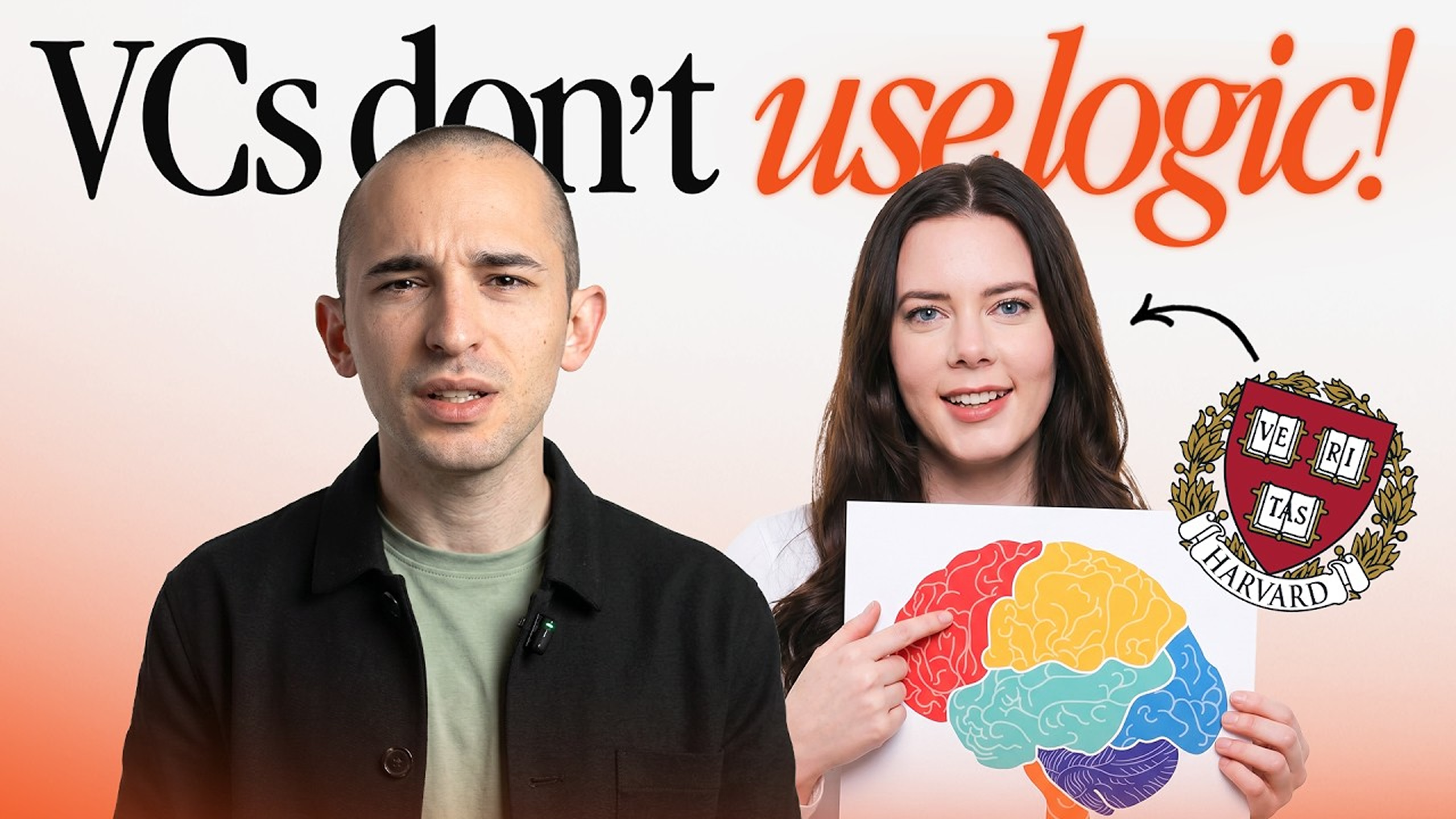
I hired a Harvard neuroscientist to reverse engineer what's happening inside a VC branch when your deck lands in their inbox. And what made them think, I need to bring that to my partner, or let's just archive. VCs make snap judgment and categorize things very quickly, even before content is fully processed.
This feels , which then is going to lead to this might not be a good investment. It's not just about having the right slide, the storytelling, the right traction, the right team. Yes, those matter. But there's one ingredient that glues everything together. And without it, your slides are just slides.
And most founders miss that ingredient. That's what we've been obsessing over. We built our methodology across 300 pitch deck, specifically engineered for how VC actually process information and as a result helped raise over 160 million. And most recently a 16 million dollar round for Amigo, an AI agent startup.
I'm Ali, founder and CEO of Amigo and we've raised 17 million dollars from top investors to prove there's a better way to do healthcare. The key to making persuasive pitch deck is to understand what drives a VC decision, the subconscious force that actually make them say yes or no. Let me show you an experiment that reveals exactly how decisions are actually made.
In 1994, a neuroscientist named Antonio Damasio studied a patient named Elliot. Genius IQ, perfect memory, perfect logic, perfect reasoning. But after a tumor damaged his brain, Elliot couldn't choose between two pen colors. Couldn't pick a restaurant for lunch. He did spend hours the entire afternoon comparing the menus.
His logic was perfect. He could analyze every option. Yet he couldn't pick one. What was missing? Emotion. The tumor had destroyed the part of his brain that processed emotion. Without it, his brain couldn't make a single decision. That's the ingredient. That's what glues everything together. For every decision required emotion, including the one the VC makes about your pitch deck.
And if your deck is all data and no feeling, the VC has nothing to anchor the decision to. Every deck looks the same. So your job is to build a deck that creates that emotion. And Elizabeth, the Harvard neuroscientist, broke down exactly how it works and how to engineer this into your deck. The problem creates this emotional tension that draws our attention.
And the solution provides that resolution and that clarity and gives, again, us or whoever you're pitching to that or the person that's being pitched to from, you know, why should I care to, oh, I do care about this and I want to help fix it. Now, you probably know the problem and the solution are really important.
But how do you actually build this emotion framework around the problem and the solution? This is exactly what I'm going to show you in this video. First, how to make a problem that triggers real emotion in a VC brain. And second, the perfect solution to release that tension. So let's get started with the problem.
So here's what most found a right on their problems like. Hiring is inefficient. Compliance is complex. The process is outdated. It sounds reasonable, but it just can't work. And here's why. If you're saying like, oh, hiring is inefficient. That's kind of abstract. That's not very clear. But if you say companies are spending, you know, two months and $4,000 and they're still not making the right hires, that makes the problem real and felt.
With this, VC can actually take those numbers and relate them to their own experience. $4,000 in two months. That's something that makes you think, wow, if that wasn't that situation, that would really suck. That's exactly the right reaction you want to create. And here's what's happening in their brain when that reaction hits. You lose clarity and you're also increasing perceived risk.
As humans, we're very risk averse and our brains are like very natural threat detectors. That's where anxiety comes from. Our brains are constantly working to make us safe. So if you're specific with your problem, you create that tension. And since the brain is constantly working to keep us safe, you're creating that desire for the VC to close the anxiety loop you just opened with the problem and make them crave to learn about your solution.
But there's one thing that can make the emotion appeal even stronger. When you can add some sort of personal story, a way that you personally relate to whatever it is that you're creating, that is going to create more emotional salience than statistics. If you personally lived through the problem, don't wait until the team slide to speak about it. Put it there in the problem slide.
Put your on it. Say, I saw this, I lived this, this is why I'm building this. It works so well because the brain responds completely differently to a person of pain than a statistic. And when a VC can see that you personally live through the problem, that it costs you, that it hurts you, their brain doesn't just process it as information. It triggers empathy.
It makes the problem feel real in a way that numbers just can't. And beyond that, it creates the ultimate moat. Because now with AI, the bar to create something has lowered massively. But your personal experience is the one thing that cannot be replicated. So it doesn't just create emotion, it creates a uniqueness.
Now, the VC feels the problem, their brain has registered a threat, and this is the moment your solution can become powerful. But if you show it the wrong way, you waste all of that tension. But before we jump to the solution, if you're watching this, you're probably raising fun and working on a fetch deck right now.
But after making 300 fetch decks and seeing which founders successfully raise or the ones who don't, I know that the deck is not the only part that makes you successful. To actually raise need much more than that and that's why I created a program that map all those steps and work on it to make sure that you can actually raise. We do venture optimization to make sure that your startup is in the right shape for VC to look at it.
We help you build your material and most importantly we introduce you to the right vc in our network and help expand your own network but because we would directly introduce you to our vc network we cannot work with anyone so we have strict criteria we evaluate you and we try to understand if you're a good fit for our program so if you're interested you can look into the video description and apply and we'll review your application and see if there's a chance we can move forward let's go back to the solution most times treat their solution slide
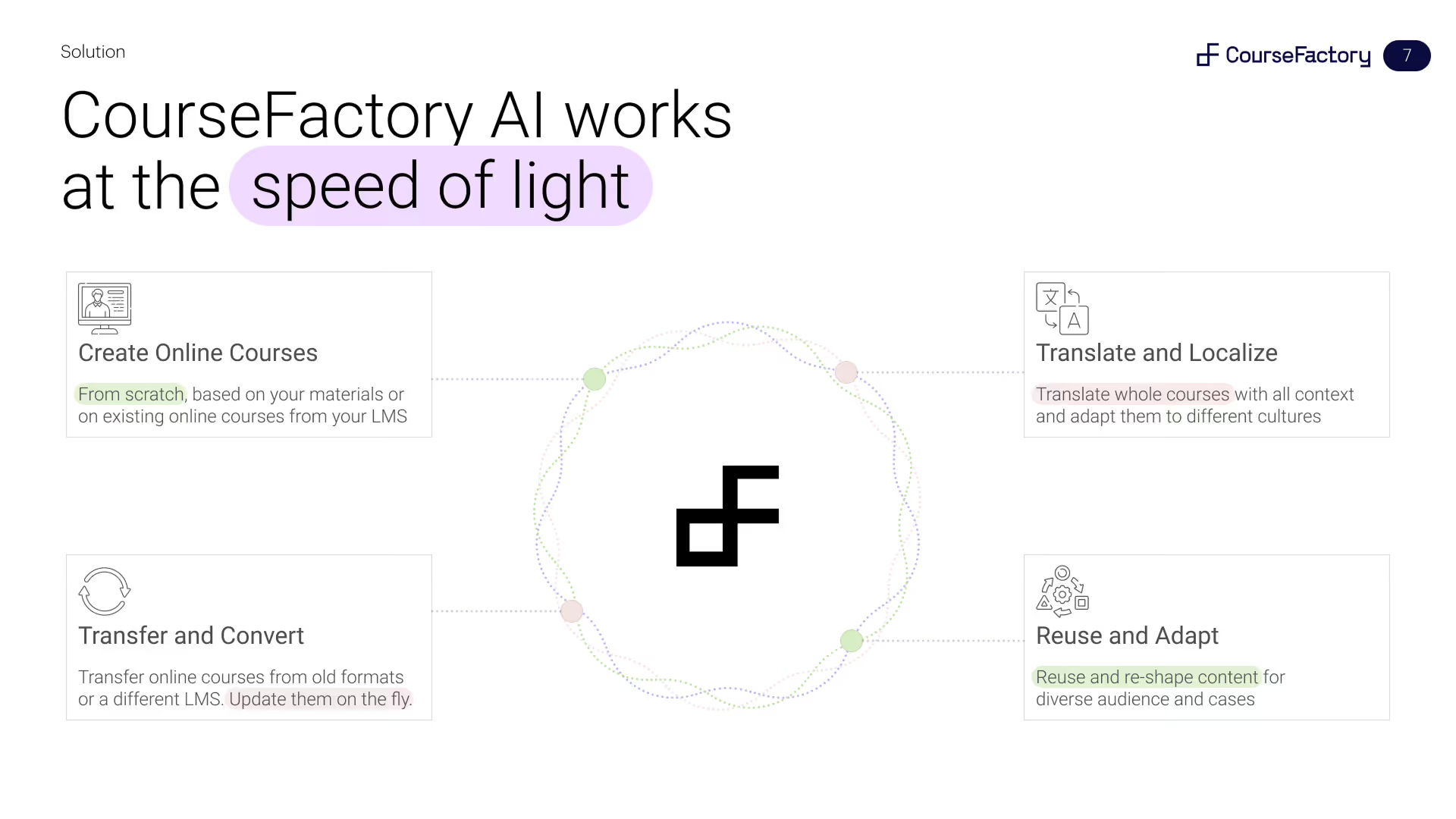
like a feature list we do x we do y a platform does z but nobody cares because the feature don't create that emotional relief your solution has to directly respond to the problem you just showed reason that the problem solution is helpful is that it increases the perceived value of whatever that thing is.
The brain doesn't evaluate value in isolation. It kind of bases that off of the change that you see. So when you have a clear before, then the after just feels a lot more important and a lot more valuable. So if the problem is $4,000 and two months for the wrong hire, your solution can be, we streamline hiring.
It has to be, we cut 90% of the cost and do it in one day. Same pain point, directly answered. That's what a clear after looks like. This is why we design our problem and solution slide as a mirror. If the problem has three pain points, the solution has to have three answers, one to one. Every piece of the puzzle completed.
The VC sees a broken process, then they see it's fixed. That contrast is what makes the solution feel inevitable. Now, if you want to know how this psychological strategy apply when you actually write a pitch, you should watch this video here, where I explain how to write the most powerful 30 second pitch for your startup.
You might also like: