Raising without traction, impossible?
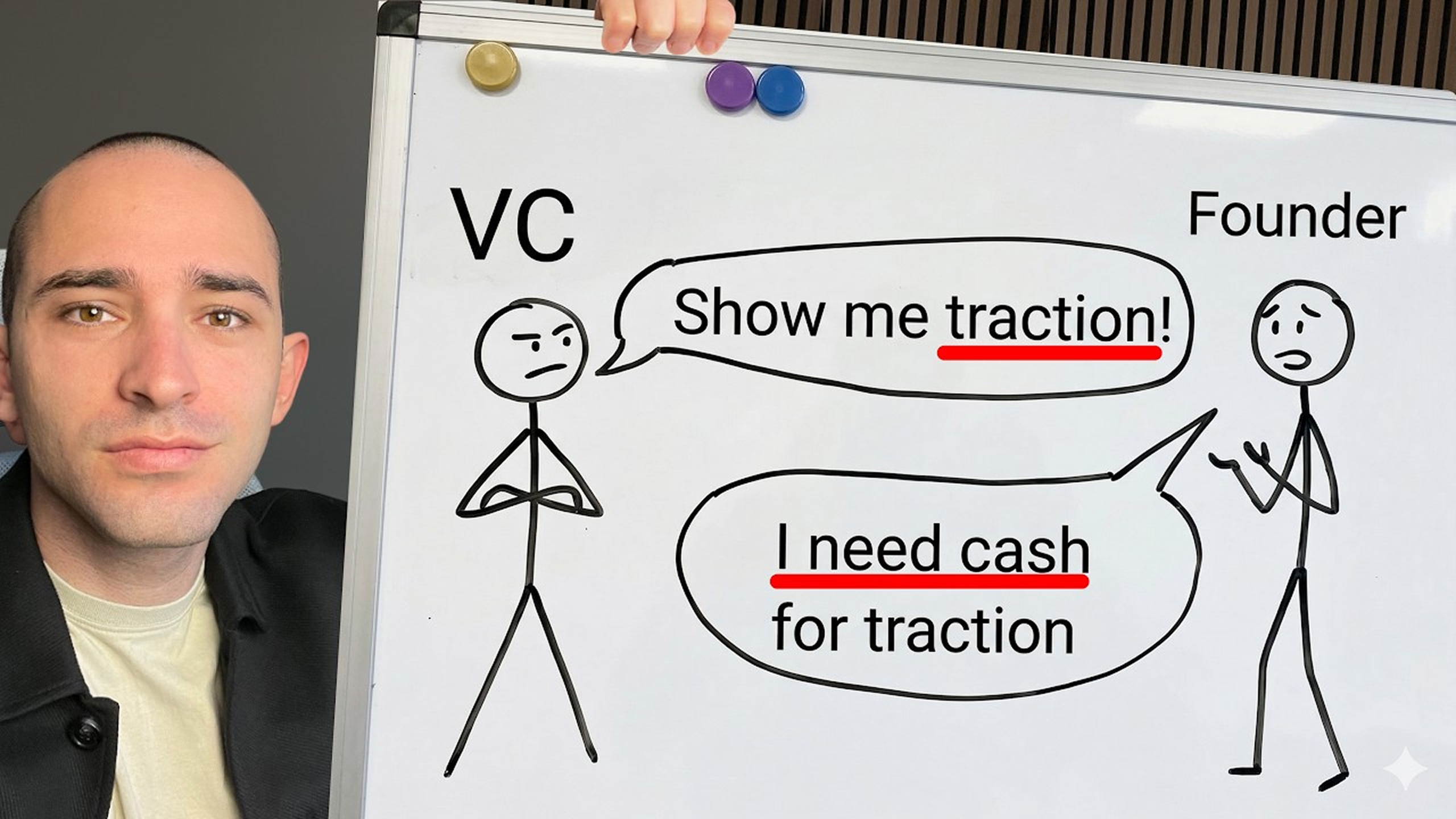
This is by far the most common problem in early stage fundraising. You go to a VC because you need money to build your product and to get traction, but the answer is that they need to see traction first. How does that work? How do you exit that vicious circle? I'll show you exactly how to do that in this video.
Now, I'm Benjamin and I'm the founder of pitchtechcreator.com. I've helped many, many founders raise over 160 million in the last four years. And more importantly, I had a lot of conversation with VCs. And in one of them that I actually had quite recently, I spoke with Yusen Kenji, the first investor in Deliveroo.
And interestingly, he first rejected them because, you guessed it, they didn't have any traction. They had some, like you probably didn't have, you probably have some traction, just not enough. But they did become a billion dollar company. So in this video, we'll cover the following. The mistake that got them rejected initially, how to find the right investor, and how much traction you actually need to get funded, and most importantly, how you can get easily more traction because yes, it's possible and most people don't use those options. Anyway, let's get started.
So the first mistake that got them rejected, it's too niche, right? Here, you're saying you didn't believe in the problem. And when that happened, it means that VC didn't understand the depth of the problem, how much it is actually a problem. And when that happened, this is where you need more traction.
And that begs the question, what is traction, right? And let's define it together. It's proof. Proof that you are solving an actual problem. Proof that your ICP cares about what you're doing. And proof is also different at every stage, right? In every stage, you need this proof. Like if you're a sales B company, VC will also ask you for traction, just not the same type of traction that you might need in the earlier stage, right? And so proof doesn't have to be revenue at the earlier stage.
And so let's get back to our story. Here, Usain, I'm sorry, but he didn't quite understand the problem well. And he said it in the podcast. And so they needed more proof. And so what to do? Right. They were speaking to the wrong investor here. The wrong category investor. Usain was not the best investor because of two things.
First, it was not his niche, right? Apparently, even though you'll see he ended up investing in the company, he didn't quite understand the problem, right? And secondly, is that it was off the stage. He's a VC and investing in later stage company. And so here, he needed more proof. The conclusion of those things needed more proof.
And so how did they solve for that? How did they actually manage to move forward and do something? And this is the topic of the part two, is how to find the right path to capital. They went to angels, right? Why is it a good idea? Because angels need less proof. The topic of part two is how to find the right path to capital.
They went to angels, right? Why is it a good idea? Because angel need less proof. And I'm going to explain you why. There's basically two categories of angels. The first one is your family and friend, people that you know that have money, your family, your friend or your network. In this case, and this is what most VC miss, is like, you are the proof.
They trust you. They know that you've been doing great stuff in the past and they want to invest in you. And you think about it, I'm sure that you would do that, right? If you have a very good friend that you know is motivated, like you don't really care so much about what they do, but you care that they do it, right? But there's no magic solution here. This is relationship.
You need to build it over the long term. But it does work. One of my clients recently raised 700 cages from friends and family. But you'll see, she also had some traction. We'll speak about that later. The second type of angels, which you can actively pursue, are, you know, angel, individual, investing their own money.
But most importantly, those are experts in a field. are, you know, individual investing their own money, but most importantly, those are experts in a field. And this is how they actually invest in early stage because they know, like imagine that you are, you know, delivery and you are, you know, you're going to a restaurant.
Well, they know the problem that you're having, right? And so they might be the first person to invest because they understand what you're doing right and that that would have been a great target for them and so but in their case they don't know you so they need to trust you and this is why we say that your team is so important in the beginning and you should really sell yourself especially when you pitch to angels and this is is what they did, right? But when they did it, they did have some traction.
And so that raises the question is, how much traction do you actually need, right? So let's continue with the example of Deliveroo. They started in January of 2020. not actually, in 2013, in 2013, right? So way, way, way back, right? And by September 2013, not 2023, they had raised £100,000, right? So about a little more than 100K.
By then, they had a few restaurants that they were doing delivery for. And most importantly, the founder was doing the delivery, like five hours per day on that beautiful delivery bike. And so, what does that mean for you? How much traction do you need? And here, how much proof do you need if you're about to raise your pre-seed or seed? The reality is there's no magical answers.
Like, you know, it really depends. But there's something you can do to find that answer. And it is to do the fundraising dance. Go to a VC, even if you're too early. Get rejected. And try to understand why, when you are in that meeting, this is a key thing you need to ask.
like, hey, what would be what would you expect from me? When would be you know, it's probably you acknowledge that you're probably too early, like, hey, I'm probably too early. But what would be something you'll be able to invest in? What kind of proof? Ask what kind of proof would you need? Then keep doing more. Apply what apply what the VC tells you.
Speak with more angels, right? Try to understand their expert point of view. If possible, get them as an advisor. Get them engaged. And get them to see you. And get them to see the work that you're doing to get that traction. Manage to raise from angel and go back to VC and raise. And this is exactly what happened.
It's oversimplified obviously, but this is what they did. And they actually went back to our friend Kenji, no, sorry, to our friend Usain, and they actually got the money, right? But now, let me go back to the correct slide. This is the correct slide. But now it beg me go back to the correct slide. This is the correct slide.
But now, it begs the question, how do you get more traction easily? How do you get that traction? And here, you have to get your hands dirty. I'm not sure that it was his dream to become, you know, a delivery driver, right? But he did it, right? And so when you are in front of that situation, that VC asks you for more traction, and you say, oh, I cannot get traction.
Take a step back and think like, what are the type of things that I could do, right? Like some type of traction need cash. Yes, and you're right, right? You need cash to build your product. that I could do, right? Like some type of traction need cash. Yes, and you're right, right? You need cash to build your product.
And I get that, right? You know, how can an ICP can pay for my product if I don't have a product, right? But what you don't need a product is to interview 300 of your ICP. You don't need a product for that. You don't need a product or cash to send DMs on LinkedIn. And actually, fun fact, I just have a client that did that, like got 10 pilots by just sending 600 LinkedIn DMs and got, I think, 100 to answer.
And then out of this, 10 to sign for a pilot. It cost him zero. but what he cost him is that he cost his time, right? And I'll jump back to this a bit later. But again, you don't need a product. You don't need a product to build an audience in B2C, right? That's the kind of traction you need at the very early stage.
You don't need to have a million in revenue, but a VC will never invest if he doesn't see that you didn't do the bare minimum work. And especially now with AI, that it's super easy to, like it costs zero to do, like you just have cloud co-work and you can do a full automated LinkedIn outreach for $20 per month month right it and if you don't do that vc will think that you're lazy right so you really need to do that and so that's what i'm saying you need to do the simple things right use your time like what can you do with your time how can you upskill to get the sales going? And this is why
our good friend Michael Seibel said, quit your job and go hard, right? But now you might be like, hey Ben, I did that and it failed, right? And so here, this is where you might start to hate me, because there's only two reasons why that might be happening. And I've seen many founders hate, fear, deny to admit this.
The first reason, and it's the hardest one to hear, is that if you've been doing that, 600 DM on LinkedIn and nobody cares about it, it means that you're not solving an actual problem. It means that your ICP are not interested and that you don't actually understand what their pain actually is. And this is not the situation VC will invest in. Cash is here, not your problem.
Understanding your problem of the ICP is, and VC don't invest in founder trying to understand their problem ICP. This is, they don't invest in this. This is not sexy, particularly because there's a lot of people who do understand, and those are the people who get the money, right? There's a lot of people trying to raise.
You need to show that you're better than them. And if that's the case, you need to go back to the drawing board to try to really understand because no one will give you the money. But there's a second problem, right? The second reason that might be happening is that you don't know how to explain what you do.
And that happens, right? You need to learn how to do it. I just made a video about it, about how the OpenCode founder had this exact problem and how he brilliantly solved it. So if that's the problem that you think you have, you should definitely check out this video. That's it. Ta-ta.
You might also like: