How I raise $167M for Tech Startups
So if you're watching this video, you're probably trying to fundraise. You're trying many, many things. You have traction, you're reaching out to investors, getting intros, yet you still don't have money in the bank, right? And it feels frustrating because you're doing all the right things. I have helped raise over 150 million, actually more now, 167 million, which is help start an AI startup infrastructure for big companies to use AI and interest rates, 17 million.
And they had that problem. And now we solve that working together. And I want to show the exact framework that I go with my client to help them create the environment that VC look at, want to see when before, actually before the investment. So there's six crucial elements and I'm going to not to tell you for, you know, like, oh, the fifth one is very important.
Now they're all fucking important and you all need to apply them very, very carefully. So, without further introduction, let's get started. So the first thing here, the first thing that you need to make super fucking clear is how much are you raising right like how much is that raising but that number is important but it's not it cannot be a random number throw or just like that oh last one was x month ago and now oh we need to raise no like this is the ask. It needs to be backed with the entire strategy.
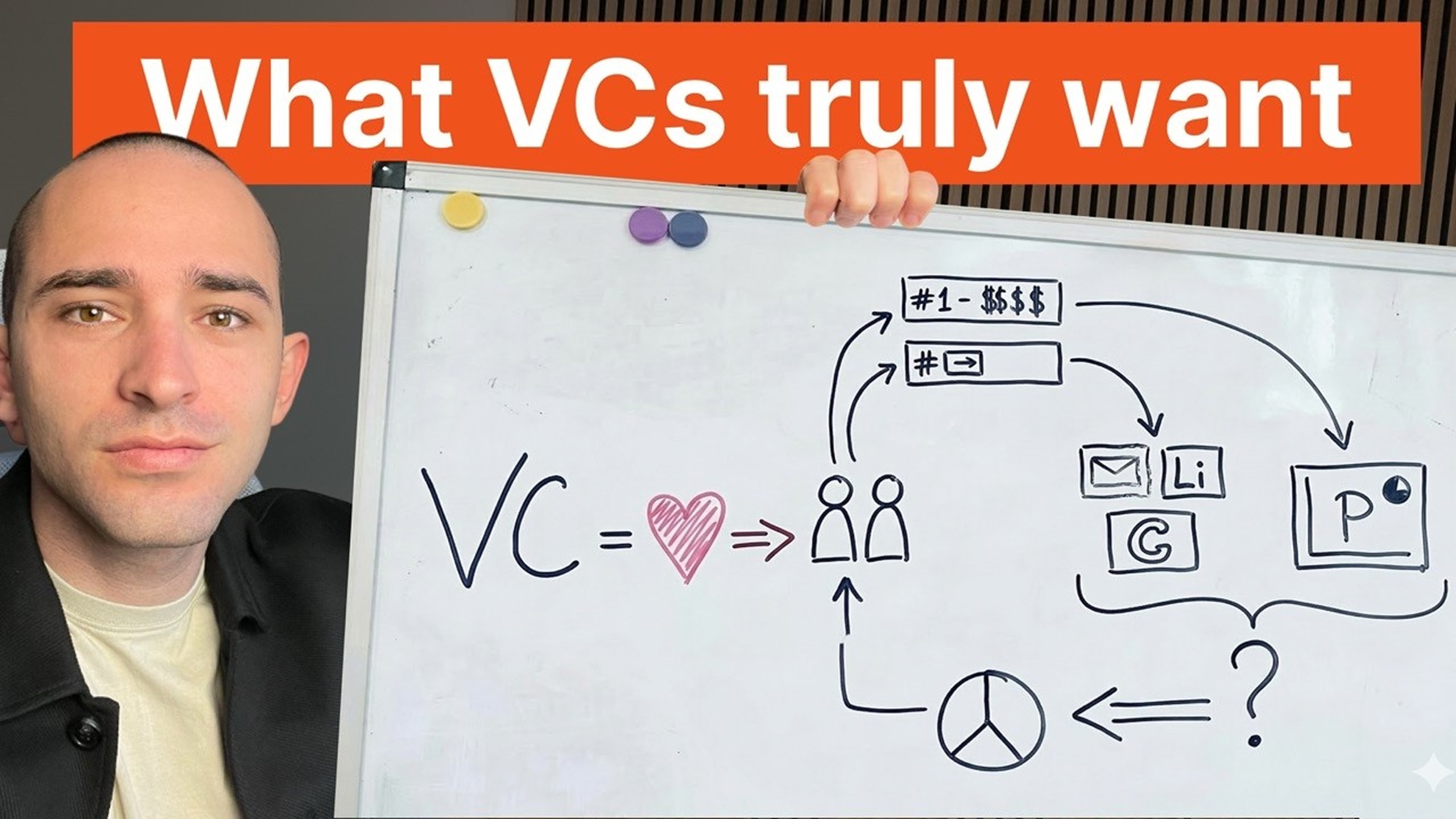
The amount that you're raising should be the conclusion of a logical and planned vote. And so the first step to plan that, right? This is kind of the final step. And usually it's put at the end of the pitch deck, but really it's the most important bit, right? And what should drive your desire to raise is what objective do you want to reach, right? And let me just write it here.
What's the objective? The objective. And this shouldn't be random either. There's like, depending on the round that you are and out and i'll make your assumption that you're seed run because this is really where we've worked the most and we're the best at like there's a clear defined thing that when you're trying to raise your seed um you should aim for let me bring a graph just to make it clear so this is what you should look at right like if right now you are in pre-seed, you know, you should have that level.
And we'll speak a bit about traction after, but you should have that traction. But then what your objective should be to become a seed company that has the potential to become a series A company, right? And that's the potential to become a series a company right and that's the main thing and so it should be clear on your ass like like yes how much you're raising but what do you gonna are you gonna do with that money and that those two things should merge like oh yeah they need some cash because boom in the balance they want to reach that objective and usually that objective is the
amount of money that you will generate in 18 months after your race because 18 months after your race as we can see on this graph which shows you know the amount of time that it takes to to raise uh from you know from uh from seed to series a well this is a bit before, but anyway, bottom line is that after your pre-seed, when you raise your seed, there should be a certain amount of time until you're ready to raise your next one. Anyway, let's, no, actually that's the right number, right? Because it's seed
to series A, right? So it should take you about, you know, two to three years to get there, right? So your objective is after you raise your seed, you should take two, three years to get there, right? So your objective is after you raise your seed, you should take two, three years to raise series A and to raise series A, you need to reach certain objective that I just showed here, right? You should reach this.
And usually the watermark is a million AR. Now that's point number one. The number you're raising should be crystal clear and backed by a strong objective and that objective should be to be able to raise the next round in 18 months and to raise your next round in 18 months you need to look you need to be shaped in a certain way which is have a certain level of revenue but then now the next logical question is how you prove that you're gonna reach that objective and that's one number two you sell with existing strategies, so your outreach, your marketing, your sales.
You just do more of what you do. Or you can also do some new stuff. on what you decide here you'll have to answer different question if it's existing strategy you'll have to prove and this is where this is where the tricky question come from right can you exist in marketing strategy scale yes or no how why if you want to do new stuff how do you know that this is gonna work like what's your proof right and we'll we'll go about this in the next point we'll explain you know how to answer those next points in the next part um and so you can also sell to old
customer or you know here i should say current customer and then here it means that you can You can either sell more of what you do or sell new stuff. And again, this will trigger another avalanche of questions. But you should have that in mind because this is the point two. And the point two is that your objective is to create new revenue, and you need to be very conscious of how you're going to generate that revenue.
Yes, your product is interesting, your problem, the solution. This is very crucial. But once you pass that, and this is usually where the company struggles, it's like, yes, they struggle, they suck at explaining the problem and solution, but even when they pass, it's like, okay, now I understand there's a problem and there's a solution, but operationally, how exactly are you going to make it happen? And this is where it breaks.
And so you should be ready to answer those questions. You want to sell to current customers, selling more of your stuff? How do you know they'd be interested about your your new offering what's your proof point and then here can your product scale can you actually sell to more people and this is where here the third point happened and this is where i'm leaving a bit of space here for the for the how do you call that the suspense it's the same one in french i should know uh the suspense here which is the question mark and the question mark is it's a nice question mark uh it's the traction, right? And this is what the traction is.
And this is the, the main thing about your startup. And this is why I call that the proof system is that your traction should be considered as a proof to back the fact that you can reach your objective. And the way you answer those questions is with some traction. And this is why traction is not equal every time so existing strategy like we're going to get more customer of existing strategy and we have our existing strategy i brought up x and we already tested to increase it by 20 and it works like we've increased it in the past and it works and look at what kind of result that
we have we believe we can keep doing that are you convinced yeah sure now attraction that is a bit less good it's like yeah we tested that new initiative but it's just the beginning or the worst worst traction is the worst thing you can have when you go to market strategies yeah we'll do social media and advertisement i'm like yeah but that's not traction that's just ideas right and that's a difference between the world of ideas and the world of traction.
One can actually be used as a proof, the other not. Same things apply here. And so this is how you should think about, this is what you should think about using your traction for and what is traction. So, for example, if you want to say like, we want to sell to new customers, we never done this before, but we've interviewed 300 person.
Yeah, that gives me the confidence that you have an idea of what could work in that instance. Now, once you have all of this, we go to point four, and this is probably the most important and it directly links it directly links with uh with this is it it is the ask it is yes but why i haven't in the ask.
Like we want to grow our product so it's more scalable. We want to grow our sales initiatives so we invest more in sales. We want to test some new stuff. So we hiring an HR, not an HR, a sales guy that worked in a company that is similar industry, blah, blah, blah. not an HR, a sales guy that worked in a company that is similar industry, blah, blah, blah. It's like what you put here is what you put in your ask with what is what will enable you to reach your objective.
And the amount of money that you raise is indeed what you put in your ask. what you'll need to raise, what you'll need to achieve your objective. And that's why that's at the end. And that's why it's really important when you're fundraising to like, and that kind of answered the question of do you need financial, you know, do you need financials when you're fundraising, even at the seed stage? Fuck yeah.
Like financials, like how much money, how are you going to use the money? And you need to be clear, right? And it's okay not to know exactly. You can pivot. You can blah, blah, blah. But at least, hey, let's have something tangible. Let's convince people that we did our homework. And then that's where it linked to the final part.
And this is kind of on its own somehow, right? And then, and this is true, the earlier you go, and it's true every time. It's like who you are as a founder. What have you done? And this is for the last drawing of mine. This is the thing that matters the most. Not the most. Like what type of founder you are.
And I've seen so many times, great company, great idea, attraction, but I failed because the founder didn't present them themselves correctly. And so this is what I'm gonna present in my next video because it's the whole chapters. How can you present yourself as a founder who makes the difference, as a founder to convince investor, what are the traits, who you should be as a founder to have convinced investor what are the traits who you should be as a founder to convince investor that's it i'll see you in the next video right here thank you very much
You might also like: